Showing posts with label vocabulary. Show all posts

Tuesday, April 19, 2011

Playing in Puddles

Today we played in puddles. When it snows, we play with snow, when it rains, we play in puddles. I remember doing this as a child and I think children do not get enough opportunities to do these things in today's fast paced world. We took out orange cones and blocked off part of the parking lot that had puddles from the mornings rain showers. The children took off their shoes and rolled up their pant legs. We talked about being safe (Paws Laws) and staying inside the area marked by the cones. We worked on skills such as jumping with two feet, following the leader, balancing on one foot, running, galloping and skipping. We also worked on expanding our vocabulary by describing how the sidewalk and parking lot felt on our bare feet (smooth, rough, bumpy, warm, cold). We talked about how the water felt (wet, cold, warm) on our feet. We talked about making splashes, ripples and footprints. This is an example of learning through play. Many cognitive, social, physical and language skills were explored and practiced during this play activity. Children learn best through play. They stay engaged longer, remember the skills better and expand on the activity independently far better than when they are just drilling skills or working on worksheets or flashcards. We hope these pictures help to give you a glimpse into the fun and learning we experienced today.

Getting ready to go play in the puddles.

Feet, prepare to get wet.

Footprints and Shadows

Ask open-ended questions like, "where does the rain come from?" and "where does it go?".  This encourages your child to use new vocabulary words, use more complex sentences and think and reason when answering your questions.  Open-ended questions are questions that cannot be answered with a "yes" or "no" response.


Ready, Set, Go!


Following the Leader

Friendships are often formed during the quiet times of discovery and exploration.


Puddles aren't just for your feet, sometimes you need to use your hands to really explore the world around you.

Poetry in Motion

Blast Off!


One of my favorite pictures of the day.  The purposeful stride of the child walks as he walks through the puddle exploring the world around him, the shimmer and shine of the sun on the water and the tree reflected in the puddle.  A child's world is truly a remarkable place isn't it?


Ripples in the water.  Ripples was one of the new words we learned today.  When you jump into the water circles will form around you.  It was neat to watch.

SPLISH, SPLASH.  These were fun words to use today.


Monday, April 18, 2011

Jumping Jelly Beans!

Today we painted with jumping wind up Jelly Beans and Easter Eggs.  The children focused on fine motor skills, taking turns, mixing colors, color identification and vocabulary expansion.  They had so much fun watching the Jelly Beans jump across the paper!  They were able to explore the what happened when the Jelly Beans jumped through thin paint and thick paint.  They also made circle prints with plastic eggs and used fine paint brushes to paint with the remaining paint.  Enjoy watching the video!

Tuesday, March 1, 2011

The Amazing Milk Magic Trick

Today we did a really cool milk experiment.  We video taped it so you could do it at home with your child.  It is simple and so much fun!  It is also an art project.  I am posting the video and the pictures for your enjoyment.  Let me know if you do this at home.  This is a great project for one of the rainy days when you are stuck inside this spring.


After we finished showing the children how to do the experiment we let the children perform the experiment themselves.  They each got their own pan and filled it half way full with milk.  The practiced their fine motor skills by squeezing one or two drops of food coloring into the milk and just one drop of dish soap into the center of the food coloring.  They then used their toothpicks to make swirls and lines through the food coloring.  They also dropped more plain milk into the swirls of food coloring to see if anything would change.  Below are the pictures of the process and the results.  The children were so involved and the experiment lasted almost 45 minutes.  Who ever said children had short attention spans?  It just depends on how interesting and relevant the project is and how involved they are allowed to be in the process.

Carefully adding a drop of blue food coloring into the pan of milk.

The food coloring immediately separates and flows to the sides of the pan when the dish soap comes into contact with the milk and food coloring.  The concepts of chemical reactions and surface tension are introduced in this activity.

Each child was able to do their own lab experiment.  Children need early exposure to math and science and they need to experience science in a way that is hands-on, fun, magical and fascinating in order to create a life long interest in the math and science arts.  This early exposure to lab experiences and science vocabulary is crucial to creating students who enjoy and not dread taking math and science classes in middle and high school.

Ta DA!  Magic.  The star pattern appears as the soap hits the milk and food coloring.


Now the children are adding additional drops of food coloring after the initial experiment had been completed.  The new drops no longer scatter when the dish soap is added.  Now the colors just merge and swirl.

Milk art.  Now our science experiment is becoming an art project.  Many times art and science are interrelated.  This is way it is critical that art programs remain in school programs.  Children become much more involved in scientific concepts when presented in artistic presentations, such as mixing different colors, different textures, solids, structures, sounds.  As we erase the arts we also erase math, language and science proficiency.

The children used vocabulary words like swirly, layers, mixing, yucky, cool, crazy, combining, coming together, floating, spreading out, moving and many more as they watched the changes as they added, stirred and mixed the colors.

The more we mixed, the more complex the patterns became.

One child said this looked like a storm cloud.  Making these types of comparisons shows the development of higher level thinking and shows that the child is assigning meaning to their art.

The children spent a lot of time trying to find pictures in their milk art.  Some saw rainbows, waves, flowers, hearts, butterflies, blood, chocolate milk, clouds, lines, and roads just to name a few.

What do you see when you look at this picture?  What can you do with a pan of milk, some food coloring, a few toothpicks and some dish soap?  How long can you play with your child, have a conversation, laugh, expand their vocabulary, ask open-ended question, have fun, connect and just enjoy each other's company?  I dare you to play in your milk!  And don't worry if you spill some, we did!

Saturday, February 26, 2011

The blue tornado experiment and video

Ms. Sarah found a way to make a tornado by using milk (which we added a few drops of blue food coloring to for this video) and water.  You can recreate this experiment at home by following the steps illustrated by Ms. Sarah in this video.  She used one of the droppers you use to give medicine to an infant or toddler.  It is very easy and as you can tell by the children's reactions, very exciting.  This experiment causes the children to use the process of scientific reasoning to figure out how the tornado works.  Vocabulary used after this experiment was done included words like vortex, circular, uplift, swirling and spinning.  The children also expanded on the activity by trying to recreate the experiment by placing the milk at the top of the container to see if the results would be the same.  They made their hypothesis and tested them.  The children were also encouraged to do this experiment without the teachers help to see if they could recreate the results.  The act of squeezing the bulb, controlling the flow of milk and placing the milk carefully at the bottom of the container took a large amount of concentration and fine motor control.  The children also had to wait patiently for their turn and negotiate who would be first and if they would work together.  And they thought they were just playing in milk and water!  Enjoy the video and let us know how the experiment works at your home.  Take your own video and send it to us.  If you don't video your child's face we will post it on our classroom blog.


Thursday, February 10, 2011

Science Flash Cards | Have Fun Teaching
Science Flash Cards Have Fun Teaching
Just wanted to share a link that I found to a site that has some weather related vocabulary cards that can be printed and used at home to support our science unit. We will be printing these at school and using these in our science center and at circle time to expand vocabulary and explore new science concepts. I hope the new links I post will give you some new tools to use at home with your child(ren). There are many sets of vocabulary cards at this site that you can print and use at home as journal starters, story starters, print two sets for matching games, make a beginning letter sound game, hide the cards and do a seek and find game or play a memory game with the cards. Let us know how you use these cards at home!

Monday, January 24, 2011

snow and ice

We hope you all survived the snow and ice January has brought us!  Sorry I haven't posted since the Ronald McDonald House Event.  The snow and ice have put me a little behind to, not to mention the holidays!  Some of December and January will be mixed in together for the next couple of posts until I can get caught up so bear with me.  For this post I am posting about what we did today taking advantage of the snow and ice.  Here are a few pictures of the students doing some snow painting.  I am also including some pictures of the children doing some ice painting  last week before the snow days (who knew we would have the real thing happening?).  Enjoy!  Come back often.  I have a lot of catching up to do so I will be adding a lot of posts over the next few weeks.

In this picture dried tempra paint was put on paper and the children used frozen water to "paint" their pictures! 

The children learn how to blend colors and practice their pincer grip for writing.

This is a great snowy day activity to do at home.  Just freeze some ice cubes, add water color or regular paint (may I recommend the washable kind!) and let the children go crazy.  You may even want to join in the fun.

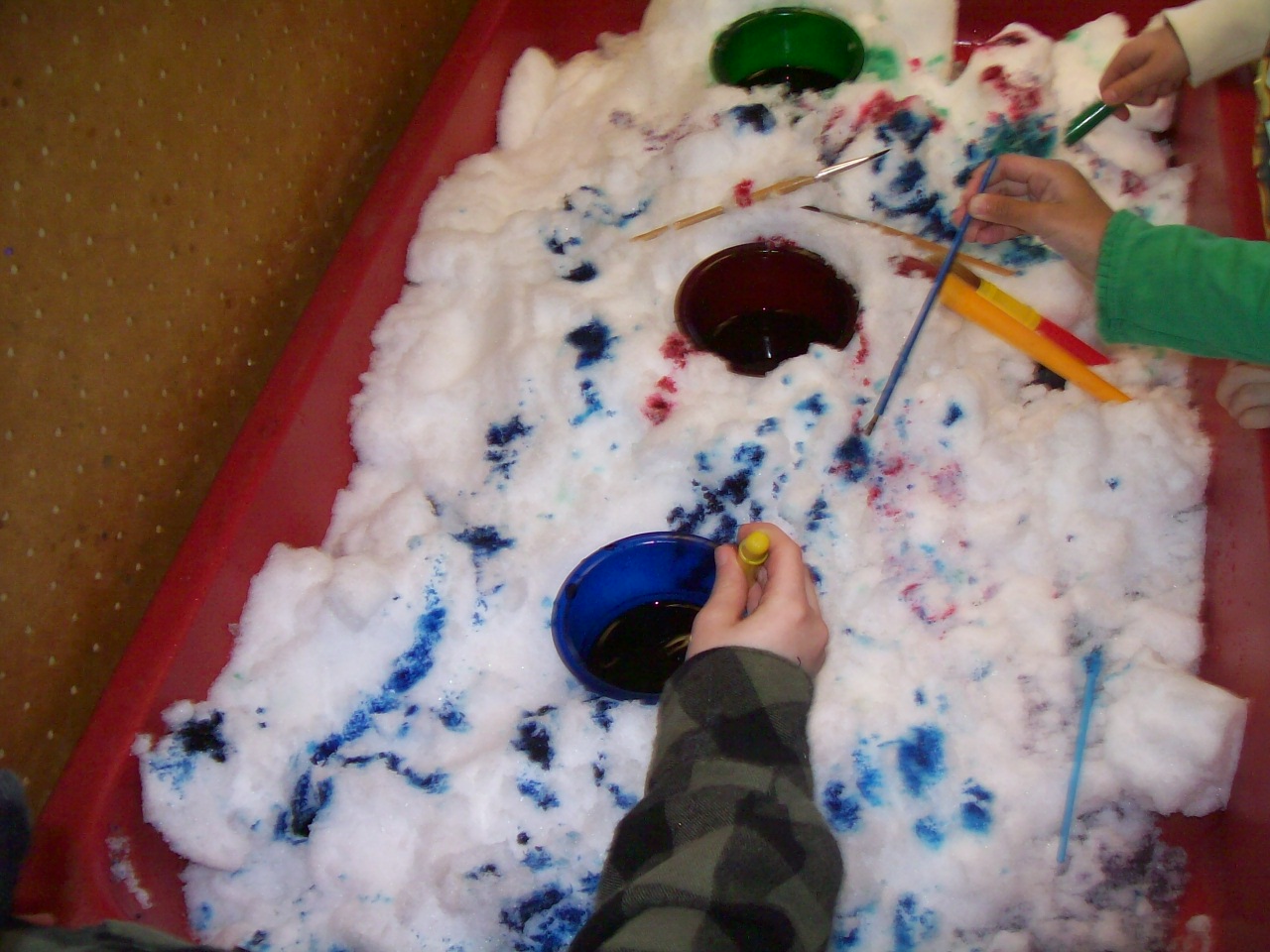
We had some water color paint left over from spray painting snow last week and wondered what we could do with it.  We brought some of the snow in from outside and placed it into the sensory table.  We placed large and small paint brushes in the table with the water color paint and waited to see what the children would create.

A blue snowman!


The children realized that this snow was different from the snow we played with last week.  This snow was "heavier" and "stuck together" better.  Some made snowballs.  Some of the students went and got their gloves and mittens out of their cubbies because their hands got cold but they didn't want to stop playing.  What great problem solvers!

Working together.  Playing collaboratively meaning to play interactively, not just side-by-side.  These two students are talking back and forth, working together to create a picture together, discussing what colors to use, how to take turns and who should paint where.  They were using lots of social and descriptive language.

Again, next time their is a snow day, fill up the bath tub or sink with snow, color some water with food coloring (watch out though, it will stain) or water down some paint, get out some paint brushes and let your child(ren) paint a masterpiece.  Better yet, paint with them.  Build sculptures inside or outside and paint them.  Don't forget to take a picture and send it into school with them so they can tell us all about it.  Believe it or not, this is where the real learning takes place.  It is not just play.  Size, shape, colors, number, language, sharing, taking turns, working together, problem solving and just plain having fun and making memories all are vital to your child's long term development.

In the afternoon class one of the other teachers gave them some ice cycles to examine.  Even though our lesson plans didn't have ice cycles in them the kids taught us a thing or two!  They put them in the sensory table and started painting them with the water color paint.  They turned into beautiful works of 3-D art!

One thing we have learned as teachers, always listen to the children.  They see the world in ways that we have forgotten as adults.  They saw the ice cycles as something different than just plain old frozen water dripping off the building.  They saw them as dazzling, magical and amazing objects to be painted, explored and manipulated into something new and even more beautiful than they were before.  I think that is why we love our jobs so much, we get to see the world fresh and new each day again, and not the way we are taught to see it as adults.  See the snow and ice as the children do.  Glittering.  Soft.  Fun.  Cold.  Yummy.  Not as we are taught to see it as adults.  Inconvenient.  Annoying.  Difficult.  Sometimes just changing your perspective can bring about joy in places you forgot it existed..

So, until next time, try to find a little fun in the snow.  It will be gone soon and before you know it the days will be long again and we will be in shorts and it will be 100 degrees outside and we will be wishing we would have enjoyed the snow while it was here.  With that said, drive safely.