Showing posts with label brain development. Show all posts

Monday, March 21, 2011

How To Make Duck Soup

This was the book we used for our Friendship Feast in late February.  The children loved this story and we highly recommend it!  It is all about a duck named Max and how his friends help save him from his own soup.  Have the children look at this cover and see how much of the story they can tell you.  This is a great activity for helping them build their long term memory, remembering story details, characters, setting, story sequencing, events, plot and increasing the general love of reading. It helps if you read the book first so you can help them recall the story and the sequence of events.  The following pictures show you how they made their own soup for their Friendship Feast. 
 No ducks were harmed in the making of this soup!


The children cut the potato's with plastic knives after the teachers cut the potato's into smaller pieces.  The children were closely supervised.  This was a great fine motor activity and helped them build the small muscles in their hands that they will need to grasp writing utensils properly so they can form letters and words.


We also did a science experiment with onions.  We cut them on the table and they made us cry!   We talked about the gas that was released into the air when we cut open the onion.  Then we cut the onion under water (we filled up a dish pan with water to do this) and we did not cry.  When you cut an onion under water it diffuses the gas and it does not reach your eyes and your eyes do not get irritated.


We took turn adding ingredients.


Everyone adds a little bit of love to the soup.
 
We asked what Max would add to his soup so the children would have to refer back to the book and take previous learning (from the book) and apply it to current learning (making the soup).  This is how long term neural pathways are formed in the brain.  Children need numerous opportunities to reapply previously gained knowledge to current activities for learning to be meaningful and relevant.


Oh-la-la!  The soup!  (They say Oh-la-la in the book so we said it too!)


Watch out MAX!  Don't eat the duck!
 
The children set the table for their friends in the afternoon class and added Ms. Beth's ducks to the soup.  Thank you Ms. Beth for letting us borrow your little ducks.  We thought they were funny.


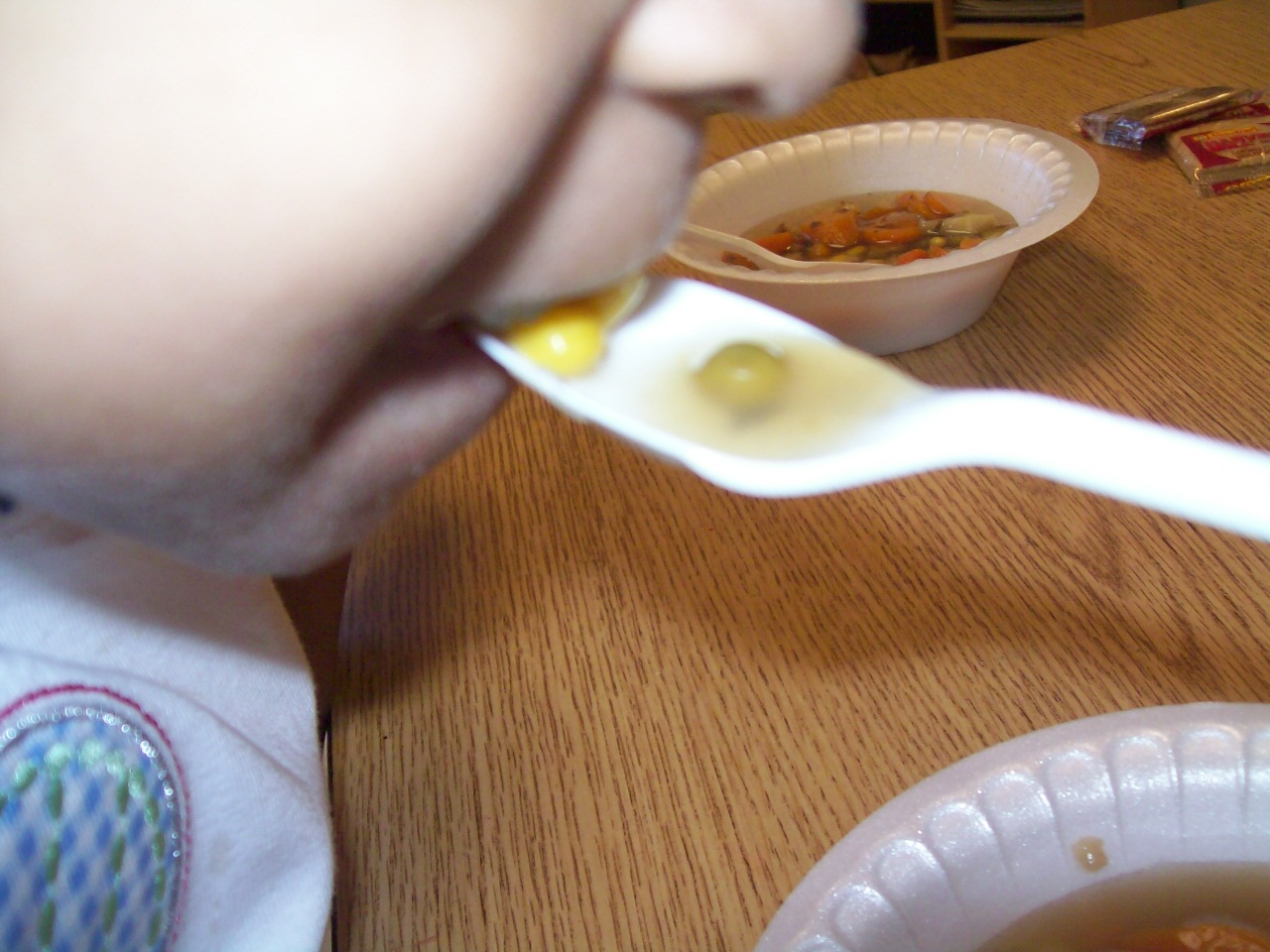
We had children that normally would not even try a vegetable try the soup.  Some loved it, some did not like it, but they all tried it.  We think it was because they got to make it.  They were invested in the process.  The activity was more like an art activity than a cooking activity.   The more involved a child can become in an activity like cooking a new food, the more likely they are to try something new.  We all had a great time with this book, with this activity and with each other.  We hope you enjoyed looking at these pictures and talking with your children about this experience.  Feel free to write down their reflections on these pictures and send them to us in an email or in their backpack so we can add it to their portfolio and use their reflections to help us plan further lessons.


Saturday, February 26, 2011

The blue tornado experiment and video

Ms. Sarah found a way to make a tornado by using milk (which we added a few drops of blue food coloring to for this video) and water.  You can recreate this experiment at home by following the steps illustrated by Ms. Sarah in this video.  She used one of the droppers you use to give medicine to an infant or toddler.  It is very easy and as you can tell by the children's reactions, very exciting.  This experiment causes the children to use the process of scientific reasoning to figure out how the tornado works.  Vocabulary used after this experiment was done included words like vortex, circular, uplift, swirling and spinning.  The children also expanded on the activity by trying to recreate the experiment by placing the milk at the top of the container to see if the results would be the same.  They made their hypothesis and tested them.  The children were also encouraged to do this experiment without the teachers help to see if they could recreate the results.  The act of squeezing the bulb, controlling the flow of milk and placing the milk carefully at the bottom of the container took a large amount of concentration and fine motor control.  The children also had to wait patiently for their turn and negotiate who would be first and if they would work together.  And they thought they were just playing in milk and water!  Enjoy the video and let us know how the experiment works at your home.  Take your own video and send it to us.  If you don't video your child's face we will post it on our classroom blog.


Tuesday, February 22, 2011

Connecting to past learning - from dinosaurs to glaciers

 Earlier this year we did a unit on Dinosaurs (go back through our blog to refresh your memory on paleontology).  During the second semester we are connecting what we are learning now to what we learned earlier this year.  One example is our unit on icebergs and glaciers.  The children created their own glaciers and icebergs out of the abundance of snow  during the January snowstorms.  During the process of freezing and melting the snow each day some of the animals they were playing with in the sensory table became frozen in the iceberg.  Some of the children made the connection to the dinosaur unit back in November in the following way.  Dinosaur bones became trapped in rocks.  The Arctic animals they were playing with became trapped in the ice in the sensory table.  People who tried to get bones out of the ground or ice are called archaeologist.  The children remembered that they were being archaeologist when they started digging the play animals out of the ice in the sensory table.

 They connected their current play to their past play.  This is called LEARNING!  And this critical type of learning cannot be achieved without hands-on, child-directed play. 

You will see more and more play experiences during the second semester that connects current play to past play creating more concrete and long term learning.


These children are excavating, using their tools, chiseling through the frozen ice trying to free the frozen animals from the glaciers.  The students are developing fine motor skills, strengthening their hands for proper grip on writing utensils,  working together as a team to remove the ice, problem solving  how to remove the hard ice without using warm water, how to negotiate space and take turns, using their vocabulary, and most importantly, using their past knowledge learned during our dinosaur unit and applying that knowledge to thier current play in the sensory table.


What animals are frozen in the icy waters?  Which ones are mammals?  Do they get cold?  Why?  Why not?  What keeps animals from getting cold in the icy water?  Make sure you ask good open-ended questions and not just yes and no questions.  You might be amazed what the children will teach you!


Now the children wanted to create their own glaciers and icebergs.  Needless to say, Ms. Sarah, Ms. Nancy and Ms. Carole Dawn spent a lot of time bringing in snow from outside so our young scientists/meteorologists could create their own glacier.  Some of the students even created their own land masses.  Maybe we will have to teach the children about places like Iceland and Greenland and put up maps that show cold places like Antartica.

These students created several glaciers and noticed that rivers formed between them.  Next they wanted to create boats to navigate between the glaciers.  With this activity the students showed an interest and an acuity toward understanding land formations, waterways and how people travel by land and water.  This is one of the most critical ways we find out what the children are interested in and how we can create activities that spark their imaginations.

Saturday, February 19, 2011

Education for the Real World | BrainWorld

If I could beg, plead, mandate, or force each of the parents of every child I have ever taught or ever will teach to read just one thing about how their child's brain actually learns this would be the article.

Theses are scary time for education. 100 teachers and administrators laid off. Huge budget shortfalls for states leading to unimaginable cuts in early childhood, elementary, secondary and special education. Larger classrooms. Smaller budgets for education. Fewer resources for special education. It is critical for parents to know how their child's brain learns, what the latest research shows is best practice for education and how to advocate for the best possible education in these financially tight times.

It is also more important than ever that parents take their role as their children's first and most important educators seriously and support their child's education at home. I think this magazine does a great job of putting education and brain research into plain, enjoyable and easy a to understand language for parents and educators to understand. It also has many practical ideas to use with your children both in the classroom and at home.

PLEASE read this small article and come and talk to me about it, email me a short little message about what you thought about the message or just drop me a note about what you learned or tried at home. Educating your child is a team effort, we do this together, in tandem. It is dance. We take turns leading and following with your child. The old African proverb "It takes a village to raise a child" is very true and very much alive in our classroom philosophy. Email me at cdleading@yahoo.com when you read this. I am looking forward to hearing your thoughts.

Enjoy your long weekend. Do something fun with your child. Below is the direct link to the article. Just click on it and away you go!

Education for the Real World BrainWorld

Wednesday, February 2, 2011

A winter' walk

We try to let the children experience art in many different forms.  One of the forms they love is photography.  They have their own digital camera that was donated to the class last year by Leah's mom and dad.  They use the camera all the time.  After the first snow storm in January we took the children on a nature walk with the camera.  We encouraged them to look around very carefully and take pictures of anything that captured their attention.  Visual discrimination is a very important skill for reading and writing.  This is one of the reasons taking away art education in school programs is so detrimental to children's learning.  Children that have to opportunity to experience the world in many different ways, not just by reading about it or listening to a teacher lecture, have greater recall and process information into their long term memory better and more efficiently.  Children who have more hands-on experience and have multiple opportunities for those experiences make more neural connections in the brain which in turn makes learning new information easier.  This is why we do nature walks often and we have the children document these walks through photography, journaling and story telling.  This are critical components to reaching back into their memories and pulling out previous information. Children at this age learn best through imitation and repetition, so by role modeling and providing lots of opportunities to repeat activities your child has the best chance of creating long term neural pathways in the brain that create "highways" for future learning.  Enjoy the pictures.  Some where taking by the children and some where taken by me when the children pointed out an object they found interesting.  I encourage you to repeat this activity at home several times over the seasons.  The recent ice and snow will create some wonderful opportunities to capture fantastic ice pictures.


Monday, January 24, 2011

snow and ice

We hope you all survived the snow and ice January has brought us!  Sorry I haven't posted since the Ronald McDonald House Event.  The snow and ice have put me a little behind to, not to mention the holidays!  Some of December and January will be mixed in together for the next couple of posts until I can get caught up so bear with me.  For this post I am posting about what we did today taking advantage of the snow and ice.  Here are a few pictures of the students doing some snow painting.  I am also including some pictures of the children doing some ice painting  last week before the snow days (who knew we would have the real thing happening?).  Enjoy!  Come back often.  I have a lot of catching up to do so I will be adding a lot of posts over the next few weeks.

In this picture dried tempra paint was put on paper and the children used frozen water to "paint" their pictures! 

The children learn how to blend colors and practice their pincer grip for writing.

This is a great snowy day activity to do at home.  Just freeze some ice cubes, add water color or regular paint (may I recommend the washable kind!) and let the children go crazy.  You may even want to join in the fun.

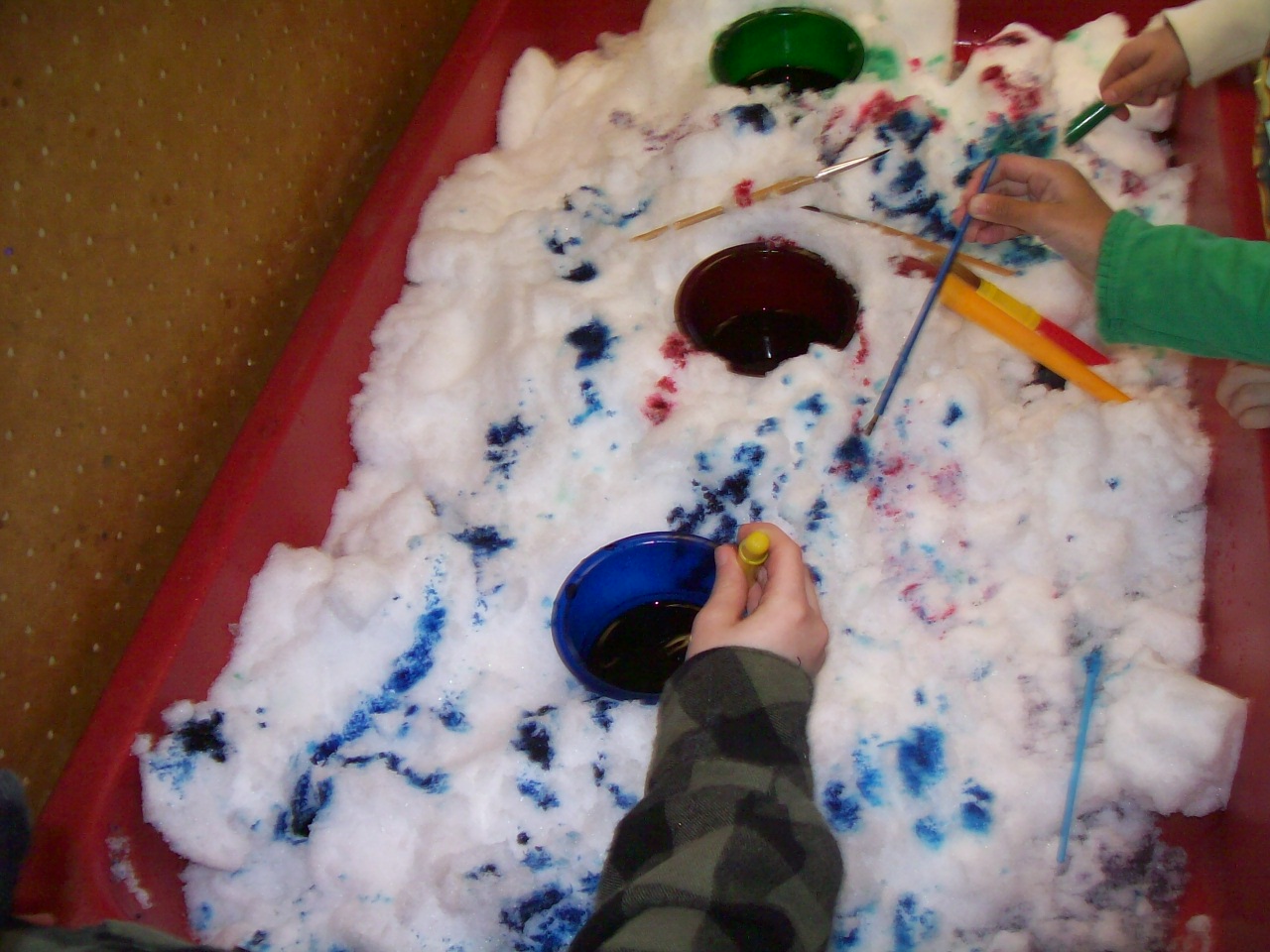
We had some water color paint left over from spray painting snow last week and wondered what we could do with it.  We brought some of the snow in from outside and placed it into the sensory table.  We placed large and small paint brushes in the table with the water color paint and waited to see what the children would create.

A blue snowman!


The children realized that this snow was different from the snow we played with last week.  This snow was "heavier" and "stuck together" better.  Some made snowballs.  Some of the students went and got their gloves and mittens out of their cubbies because their hands got cold but they didn't want to stop playing.  What great problem solvers!

Working together.  Playing collaboratively meaning to play interactively, not just side-by-side.  These two students are talking back and forth, working together to create a picture together, discussing what colors to use, how to take turns and who should paint where.  They were using lots of social and descriptive language.

Again, next time their is a snow day, fill up the bath tub or sink with snow, color some water with food coloring (watch out though, it will stain) or water down some paint, get out some paint brushes and let your child(ren) paint a masterpiece.  Better yet, paint with them.  Build sculptures inside or outside and paint them.  Don't forget to take a picture and send it into school with them so they can tell us all about it.  Believe it or not, this is where the real learning takes place.  It is not just play.  Size, shape, colors, number, language, sharing, taking turns, working together, problem solving and just plain having fun and making memories all are vital to your child's long term development.

In the afternoon class one of the other teachers gave them some ice cycles to examine.  Even though our lesson plans didn't have ice cycles in them the kids taught us a thing or two!  They put them in the sensory table and started painting them with the water color paint.  They turned into beautiful works of 3-D art!

One thing we have learned as teachers, always listen to the children.  They see the world in ways that we have forgotten as adults.  They saw the ice cycles as something different than just plain old frozen water dripping off the building.  They saw them as dazzling, magical and amazing objects to be painted, explored and manipulated into something new and even more beautiful than they were before.  I think that is why we love our jobs so much, we get to see the world fresh and new each day again, and not the way we are taught to see it as adults.  See the snow and ice as the children do.  Glittering.  Soft.  Fun.  Cold.  Yummy.  Not as we are taught to see it as adults.  Inconvenient.  Annoying.  Difficult.  Sometimes just changing your perspective can bring about joy in places you forgot it existed..

So, until next time, try to find a little fun in the snow.  It will be gone soon and before you know it the days will be long again and we will be in shorts and it will be 100 degrees outside and we will be wishing we would have enjoyed the snow while it was here.  With that said, drive safely.